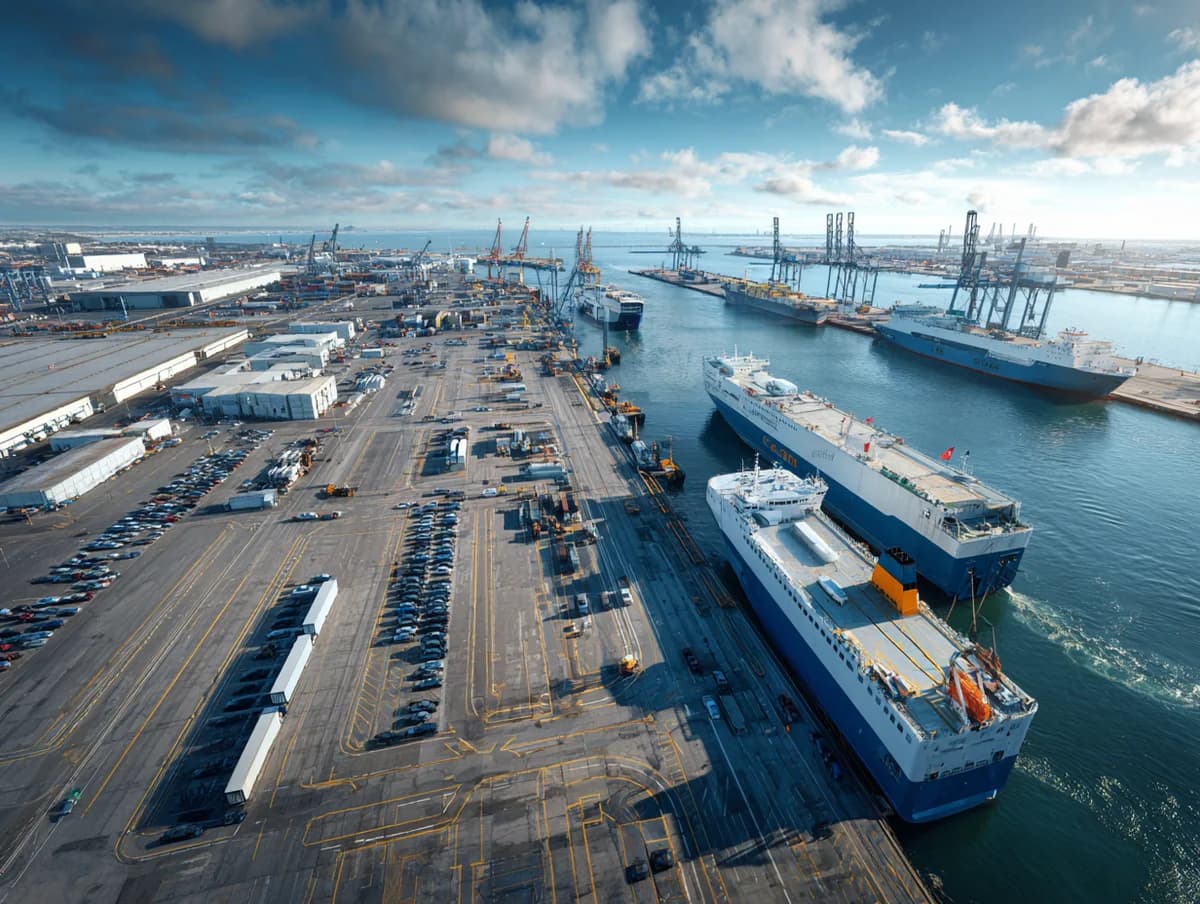
Vehicle logistics is different from general freight. Cars, trucks, agricultural and construction equipment move on VINs rather than container numbers, follow OEM-specific PDI workflows, and produce damage reports, lashing manifests, and stowage plans that container-focused systems were never designed to capture. The right software depends on whether you operate a shipping line, a terminal, a freight forwarder, a vehicle processing center, or an OEM with a 3PL/4PL network.
Below are the platforms most active in the RoRo and finished vehicle logistics space in 2026, grouped by what they're built for.
TMS, FMS, WMS or YMS: which one do you actually need
Most shortlists in this space go wrong before the first demo, because the buyer is comparing products from four different software categories against each other. The categories overlap and the vendors use the labels loosely, so it is worth being blunt about where each one stops.
TMS, transport management
Plans and executes movements: quoting, booking with carriers, routing, the inland leg, documents and freight billing. In vehicle logistics the question is whether it prices and tracks a unit or a consignment, because a high-roof van and a saloon are one unit each and nothing like the same amount of ship.
FMS, freight management
Often the same thing under a different name, sometimes a wider system that adds finance, customs and margin reporting on top of the TMS. Treat the label as marketing and ask what it does at each step instead.
WMS, warehouse management
Built for stock that sits still in racks and bins: receiving, put-away, picking, replenishment, cycle counts, often a dimensioner for cartons. Excellent at what it does, and modelling a compound full of cars in it is where the spreadsheets start.
YMS, yard management
Manages where a unit physically stands and how it moves: compounds, buildings, floors, stacked structures, individual spots, plus the activities performed on it and the charges those generate. This is the one most often missing from a general freight platform.
Which combination you need follows from your role rather than from your size.
- Freight forwarders and NVOCCs need TMS first, plus enough yard to cover the days a vehicle sits before it sails, plus export customs. A WMS is rarely the gap.
- Terminal operators and compounds need YMS first, with activity-based charging attached to it, and a TMS only if they also arrange movements.
- Stevedores working vessel calls need handheld discharge and load scanning against the line's lists, condition photos at handover and a charge per move, more than they need a yard.
- Vehicle processing centres need YMS plus inspection and rework workflows, because the work performed on the unit is the product.
- Shipping lines need capacity and voyage planning above all of it, which none of the other three categories covers.
A vendor that answers "yes" to all four without qualification is worth a second look, not a shortlist place.
Purpose-built for vehicle and RoRo logistics
1. CargoTel
CargoTel has been building software for automotive and finished vehicle logistics since 2000 and is one of the most established names in the space. Its product line spans vehicle TMS for carriers and dispatchers, a yard management system for compounds and processing centers, and EDI services for OEM and carrier integrations.
Notable capabilities:
- Vehicle Transport Management System for car haulers and FVL operators
- Yard Management System with task-oriented workflow templates
- EDI 214 and other automotive EDI message support
- Carrier dispatch, load planning, and damage capture
- Customer portal for shippers and dealers
CargoTel is a strong fit for North American auto-haul carriers and processing centers that need a battle-tested TMS/YMS combination.
2. Cognosos
Cognosos approaches finished vehicle logistics from a real-time location and visibility angle. The platform is built around RTLS (Real-Time Location System) hardware combined with software that surfaces vehicle and driver movement insights across compounds, ports, and rail yards.
Notable capabilities:
- Real-time vehicle location across yards and processing centers
- Driver activity tracking and productivity insights
- Dwell time and exception alerts
- Asset tagging via low-power tracking devices
- API access to feed downstream systems
Cognosos is most useful when the operational pain is finding vehicles fast in large compounds rather than orchestrating end-to-end logistics workflows.
3. ICL Systems (VLMS)
ICL Systems is a long-running provider of rail and vehicle logistics software, with their Vehicle Logistics Management System (VLMS) widely used by OEMs and large 3PL/4PL networks for finished vehicle visibility and TMS-style coordination.
Notable capabilities:
- End-to-end finished vehicle visibility for shippers and OEMs
- Modular TMS and yard/compound management
- EDI integrations for OEM-to-carrier data flow
- Multimodal support (rail, road, ocean)
- Reporting tailored for OEM and 3PL/4PL operations
VLMS is well-positioned for OEMs and large 3PLs whose primary need is shipper-side visibility and carrier coordination across modes.
4. INFORM
INFORM builds optimization software for vehicle logistics with a focus on planning, control, and orchestration from factory to dealer. Used by OEMs, logistics service providers, and ports, INFORM emphasizes algorithm-driven decision support: yard placement, transport assignment, and capacity allocation.
Notable capabilities:
- Yard and compound optimization (placement, retrieval sequencing)
- Transport planning and capacity allocation
- AI-assisted decision support across the FVL chain
- Integration with existing TMS, YMS, and ERP systems
- Strong adoption in European OEM and port environments
INFORM tends to layer on top of existing operational systems as an optimization engine rather than replace them.
5. Logisoft
Logisoft is an end-to-end platform built specifically for RoRo and finished vehicle logistics since 2010. The platform unifies booking, tracking, terminal yard operations, vehicle processing, customs, billing, and end-customer portals on a single shared shipment record, visible to the shipping line, freight forwarder, terminal operator, customs agent, OEM, and end-customer simultaneously.
Notable capabilities:
- Transport Management System for shipping lines, freight forwarders, and NVOCCs: quoting, booking, voyage planning, sailing schedules, container and RoRo freight, and per-vehicle profitability tracking
- Terminal Operating System for RoRo and vehicle terminals: a yard modelled down to the individual spot, gate in and gate out on the unit record, voyage capacity and per-deck allocation planning, and storage charged by the day under per-client charging rules
- Customer Relationship Management (CRM) with credit control, multi-client billing, sales pipeline, and contract management built around shipment records
- Branded Digital Portal under your own domain, where your customers receive and view quotations, submit and cancel bookings themselves, search their units by VIN, and download their own documents: draft Bill of Lading, booking confirmation, invoice
- Pre-Delivery Inspection (PDI) workflows for vehicle processing centers: inspection templates, damage reporting, claims management, and OEM-compliant condition reports
- OEM EDI connectors with Ford, Mercedes-Benz, Stellantis and JLR, including a dedicated Mercedes-Benz service for the US market, exchanging shipping instructions and status messages
- Auto-charging engine that creates billable items the moment an activity completes, eliminating the gap between operations and finance
- More than 25 live integrations with ocean carriers, automotive OEMs, customs authorities, visibility platforms and ERP systems
- Multi-stakeholder collaboration on the same shipment record. Shipping line, freight forwarder, terminal, customs, OEM, and end-customer all see what's relevant to them, with no duplicate data entry between parties
- Cloud-native and continuously updated with 127 production releases per year
- In production since 2010, with 127 releases shipped a year
Logisoft's positioning is purpose-built specialization: the workflows that container TMSs treat as edge cases (VIN-level operations, vehicle PDI, non-running units, OEM messaging, multi-client terminal billing) are core to the platform.
Terminal operating systems with RoRo support
These are multi-cargo terminal systems that handle RoRo alongside containers and break-bulk. If your terminal is vehicles and nothing else, the RoRo terminal operating system in the purpose-built section above is the closer comparison, and yard management is the part of it most operators are actually shopping for.
6. Master Terminal (Jade Logistics)
Master Terminal from Jade Logistics is a multi-cargo TOS handling containers, bulk, break-bulk, and RoRo on a single platform. It is widely deployed across mixed-cargo terminals where RoRo is one of several cargo types managed.
Notable capabilities:
- Multi-modular TOS supporting containers, bulk, break-bulk, and RoRo
- Vessel scheduling, gate operations, and yard moves
- Configurable for terminals of varying sizes and cargo mixes
- Strong installed base in Asia-Pacific and emerging markets
- Integration framework for customs and external systems
A good fit for terminals with mixed cargo profiles where RoRo is part of a broader operation rather than the dominant cargo type.
7. OSCAR (TGI Maritime Software)
OSCAR by TGI Maritime is a TOS used at more than twenty terminals worldwide, designed for small-to-medium container and mixed-cargo terminals including RoRo operations.
Notable capabilities:
- Real-time control of land and maritime operations
- Container, RoRo, and general cargo management
- Vessel planning, gate, and yard operations
- Tailored for small-to-medium terminals
- European market presence
Best fit for small-to-medium terminals seeking a focused TOS without the complexity of enterprise-tier deployments.
General freight management with multimodal RoRo handling
8. CargoWise
CargoWise is the dominant general-purpose freight forwarding platform globally. It supports multimodal cargo including RoRo and vehicle shipments as part of its broad feature set covering air, ocean, road, customs, and accounting.
Notable capabilities:
- Multi-modal freight management across air, ocean, road, and rail
- Customs declarations, AMS, and global compliance modules
- Accounting, invoicing, and multi-currency
- Worldwide operator network and integrations
- RoRo handled as a cargo type within a broader freight workflow
CargoWise is the right answer when RoRo is a small percentage of a broader freight forwarding operation rather than the core business.
Choosing the right platform
Three questions narrow the field quickly:
- What percentage of your business is RoRo or finished vehicle logistics? If it's the majority, purpose-built platforms align with how your operations actually work. If it's a minority, a general freight system with RoRo support may be enough.
- Which stakeholders need to collaborate on the same shipment? Some platforms are single-stakeholder (carrier-facing OR shipper-facing OR terminal-facing). Multi-stakeholder operations benefit from systems where the same record is visible to all parties, eliminating duplicated data entry and reconciliation work.
- How is billing tied to operations? Platforms with built-in auto-charging (where billable items are generated the moment an activity completes) close the gap between operations and finance that often costs RoRo and FVL operators significant revenue leakage.
Those three questions narrow the shortlist. Testing the shortlist is a different job, and it is the one most evaluations skip, because they end when the demo ends. Our evaluation method for vehicle logistics software covers what actually fails at eighteen months, a scale for scoring what a vendor shows you so promises and manual workarounds are not recorded as capabilities, four stages run cheapest first, and the cases where a general freight platform is the better buy.
If your operation centers on RoRo shipping, terminal operations, vehicle processing, freight forwarding for finished vehicles, or any combination of those, see how Logisoft handles the full workflow on a shared platform. Or request a personalized demo to walk through your specific operations.
Frequently asked questions
Follow on Google
Keep Logisoft in your Google feed
Mark us as a preferred source and our RoRo and vehicle-logistics coverage shows up more often in your Google Top Stories and AI results.