The UAE's role in global vehicle logistics changed materially over the last 36 months, and is about to change again. If you operate a RoRo terminal, a finished vehicle logistics business, an OEM import flow, or a re-export channel out of Jebel Ali, three things are happening at once. Chinese OEMs are now the structural floor of UAE vehicle volume, not a trend. Al Faw Grand Port goes commercial in 2026 under AD Ports Group management, opening direct deep-sea RoRo calls to Iraq for the first time. And on 1 January 2027, mandatory Peppol e-invoicing comes into force for every business above AED 50 million in revenue, which covers most of the operators reading this.
None of these are speculative. All three are dated, regulated, or measured. The operators who absorb them will be the ones who digitized first. This guide is a working map of what your operation needs to handle: every port that matters, every shipping line that calls, every customs and compliance system you cannot avoid, the re-export workflow end to end, and the platform capabilities that pull it all together.
It is long, because there is no shorter version that is honest. Skim the sections that match your role. The references at the bottom point to every primary source.
Key dates to plan around:
- 25 January 2026: Digital MAKASA Phase 1 live for intra-GCC duty reconciliation (Dubai Customs)
- 10 May 2026: UAE Pass authentication mandatory for all Mirsal-2 declarations
- 1 July 2026: Voluntary e-invoicing Pilot opens (MoF-selected participants)
- 31 July 2026: Accredited Service Provider appointment deadline for businesses ≥ AED 50M
- 2026: Al Faw Grand Port begins commercial RoRo operations under AD Ports management
- 1 January 2027: Phase 1 mandatory Peppol e-invoicing (revenue ≥ AED 50M)
- 1 July 2027: Phase 2 mandatory e-invoicing (all VAT-registered businesses)
Where your vehicles actually land
Five UAE ports handle RoRo traffic, but only two of them matter at scale. The picture is more concentrated than most operators realize.
| Port | Operator | Position | 2024 Volume | H1 2025 Volume |
|---|---|---|---|---|
| Jebel Ali | DP World | Primary gateway | 960K+ vehicles | 545K (+28% YoY) |
| Khalifa | AD Ports / Noatum (ATK) | Re-export hub | Combined +30% YoY (H1) | Combined +16% YoY (Q1) |
| Port Rashid | DP World | Iraq corridor (relaunched Dec 2025) | Not disclosed | Not disclosed |
| Hamriyah | Sharjah Ports Authority | Multipurpose, FZ-integrated | Not disclosed | Not disclosed |
| Fujairah | Fujairah Terminals (AD Ports) | East-coast hedge, outside Hormuz | Not disclosed | Not disclosed |
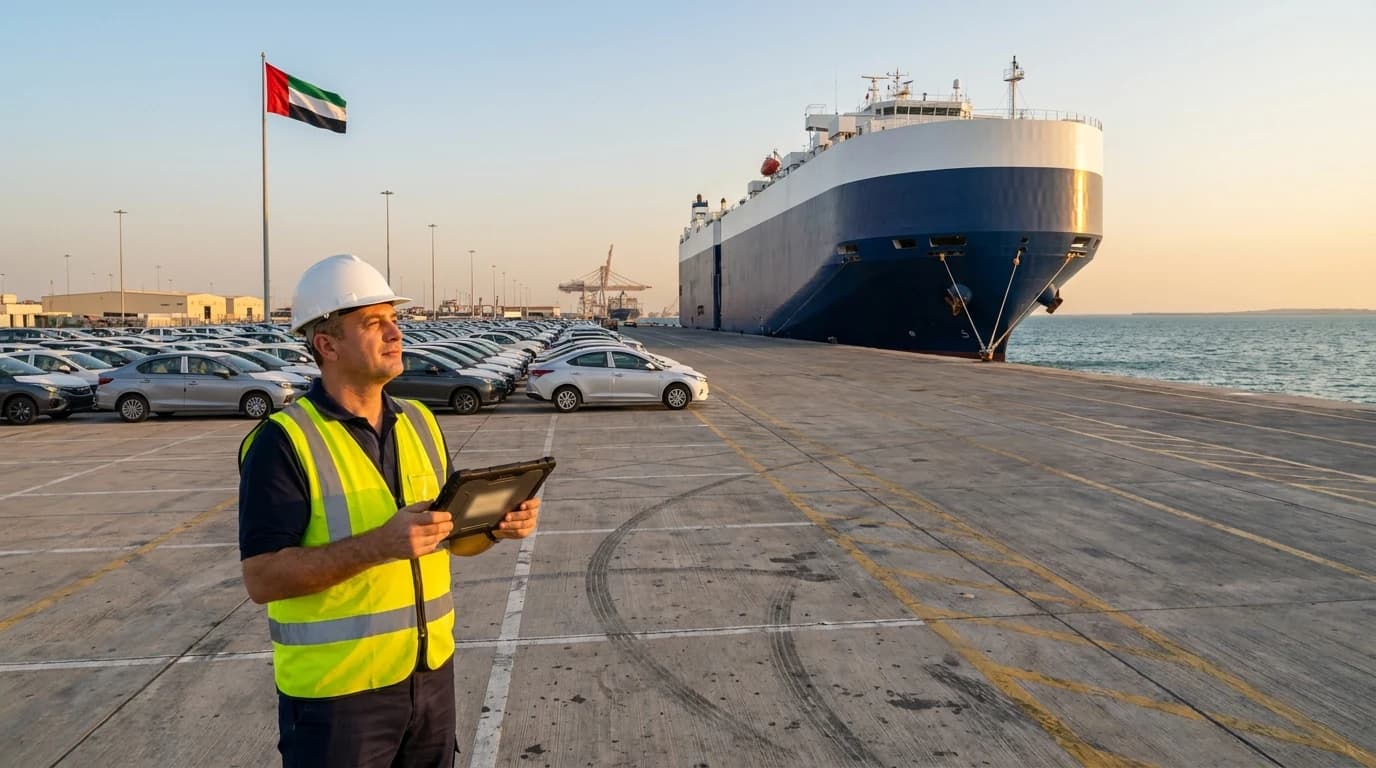
Jebel Ali (DP World) is the dominant gateway. DP World handled over 1.3 million vehicles across its UAE RoRo operations in 2024, a 53.6 percent year-on-year increase, with Jebel Ali responsible for the vast majority. The port processed 545,000 vehicles in H1 2025 alone, up 28 percent on the same period in 2024. Imports are 65 percent of throughput, sourced primarily from China, Japan, Thailand, India, and South Korea. China is now the top source by volume, not by value, that is a structural shift worth pausing on.
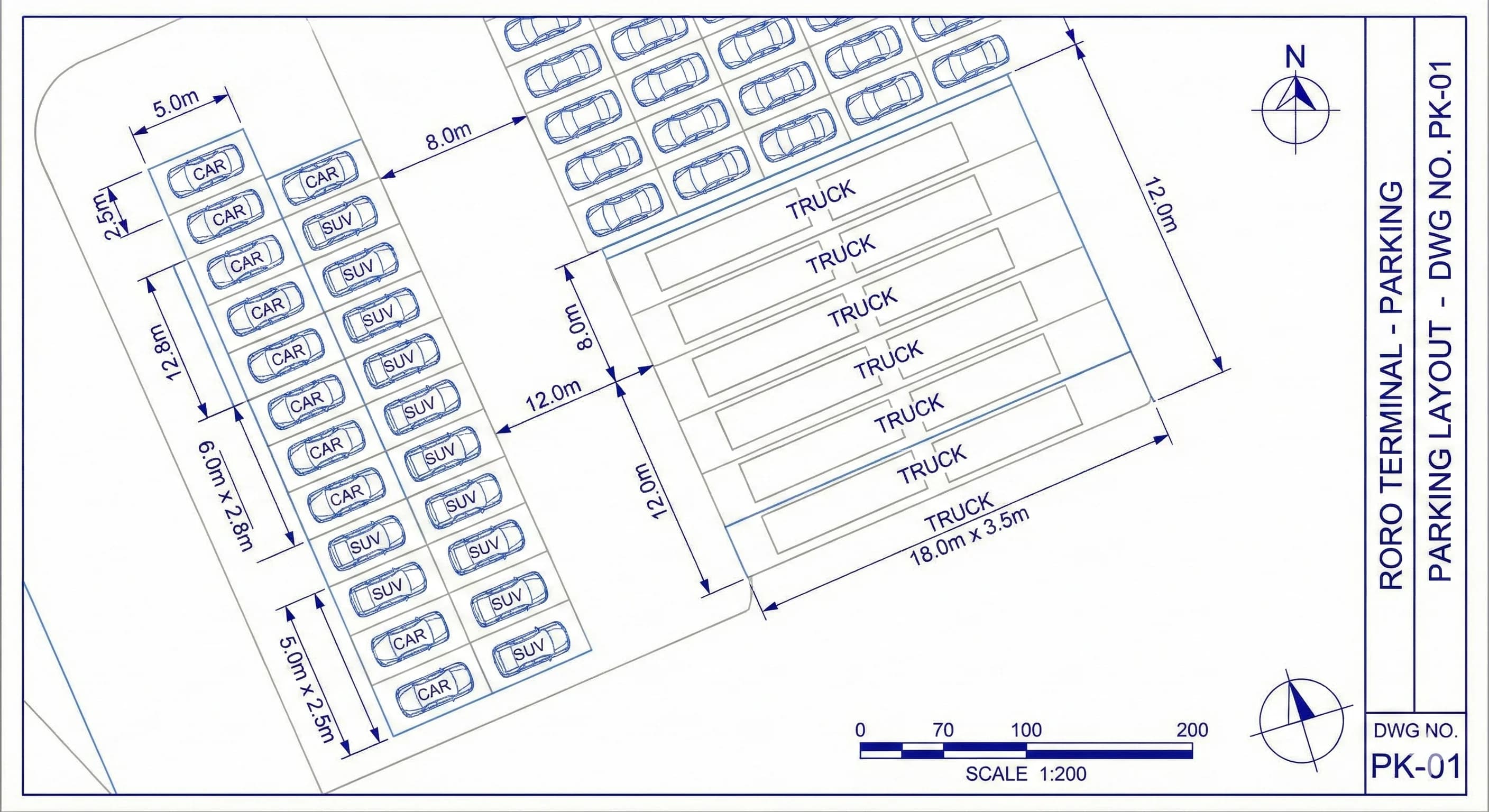
The capacity story keeps pace. RoRo operations relocated from Terminal 1 to a purpose-built area at Terminal 4 in 2025. The new T4 RoRo facility has an 800 metre quay handling three RoRo vessels simultaneously and a yard expanded to 75,000 CEUs after the addition of 13,000 CEUs in August 2025. The same expansion added a 2.6 million square foot yard to the terminal. If your operation depends on Jebel Ali, the constraint is no longer quay or storage. It is PDI bay throughput, transporter availability, and customs gate dwell.
Khalifa Port (AD Ports) is the credible number two and the regional re-export contender. Vehicle handling is concentrated at Autoterminal Khalifa Port, a 15-year joint venture between AD Ports Group and Autoterminal Barcelona under Noatum Maritime Group. The terminal has two RoRo berths, a 600 metre quay, 18.5 metre draft, a yard of approximately 320,000 square metres, and a handling capacity of 15,000 vehicles per cycle. PDI, customization, and technical services are offered onsite, a structural advantage over Jebel Ali for operators who want one location for both quay-side and value-add work. Q1 2025 saw combined Khalifa and Spain RoRo volumes reach 356,000 units, up 16 percent year on year.
Khalifa's strategic position strengthened in April 2025, when United Global Ro-Ro, the AD Ports and Erkport joint venture, launched its LNG-powered UGR Al Samha on a maiden voyage at the port. UGR plans 11 vessels across 5 services with Khalifa as the hub, feeding Gulf, Mediterranean, and Asian spokes. This is the first time the Abu Dhabi side of the UAE has a vehicle-carrier brand purpose-built around it.
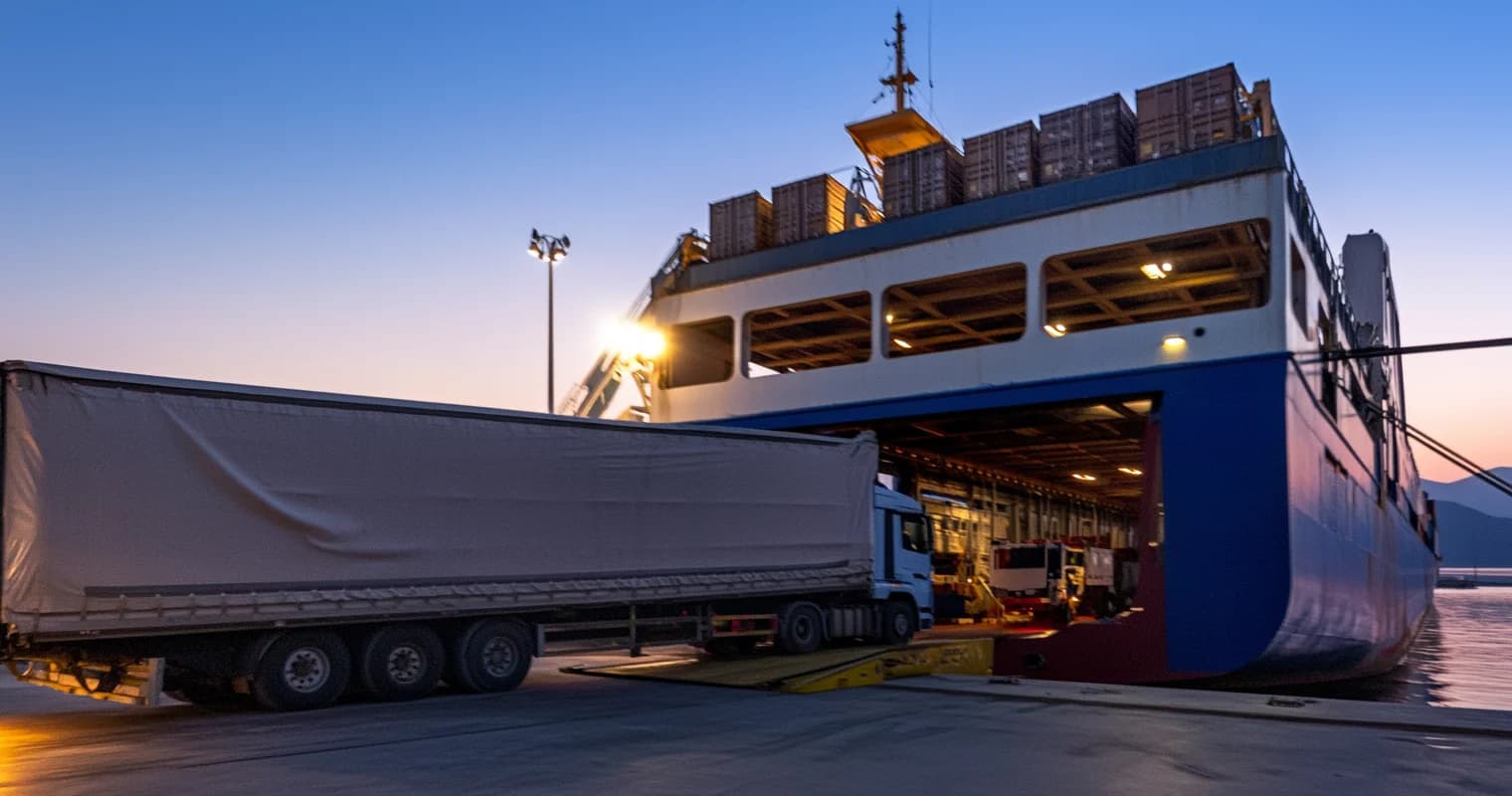
Port Rashid (Mina Rashid) in Dubai is a niche but operationally relevant node. RoRo activity resumed in December 2025 with DP World's purpose-built DP World Express vessel running a 36-hour Dubai to Iraq RoRo corridor. If your Iraq flow is time-sensitive and consignment-sized rather than full-vessel, Port Rashid is now a real option. Höegh Autoliners also lists Port Rashid as a UAE call point.
The remaining ports, Mina Zayed, Port Khalid and Hamriyah in Sharjah, Fujairah, and Saqr Port in Ras Al Khaimah, are RoRo-capable on paper but do not handle meaningful disclosed vehicle volumes. Mina Zayed migrated its vehicle traffic to Khalifa years ago. Hamriyah is multipurpose with RoRo facilities tied into the Hamriyah Free Zone. Fujairah is the only multipurpose port on the UAE east coast, outside the Strait of Hormuz, which makes it a tactical hedge in scenarios where the strait is contested. Khor Fakkan is a deep-water container transshipment hub and not a vehicle gateway despite having RoRo capability listed in its terminal spec.
If you are building a UAE strategy from scratch, the realistic operational map is Jebel Ali as your primary, Khalifa as your secondary or your re-export base if you have KEZAD tenants, Port Rashid for Iraq, and Fujairah as a contingency.
The RoRo lines you will book
The carrier picture in the UAE is heterogeneous by design. Far Eastern, European, American, and Mediterranean carriers all call, but their schedule transparency, EDI maturity, and booking workflows differ substantially. The table below is the verified picture as of mid-2026.
| Carrier | Calls UAE | UAE Ports | Origin Regions |
|---|---|---|---|
| Wallenius Wilhelmsen Ocean | Yes | Jebel Ali | Europe, Far East, Atlantic |
| EUKOR (WW Group) | Yes | Jebel Ali | Far East (Korea, Japan, China) |
| Höegh Autoliners | Yes | Jebel Ali, Port Rashid, Khalifa | Europe, India, Africa, Americas |
| Grimaldi Group | Yes | Jebel Ali | Far East (China) |
| NYK RoRo | Yes | Jebel Ali, Khalifa | Europe, Far East |
| MOL ACE | Yes | Jebel Ali | Far East |
| K Line | Yes | Jebel Ali | Far East |
| Hyundai Glovis | Yes | Jebel Ali | Far East (Korea) |
| Sallaum Lines | Yes | Jebel Ali | Europe, USA, Mediterranean |
| Liberty Global Logistics | Yes | Jebel Ali, Abu Dhabi Hamad | US East and Gulf Coast via Mediterranean |
| COSCO Shipping | Yes (confirmed first calls) | Jebel Ali | Far East (China) |
| United Global Ro-Ro | Yes | Khalifa | Asia, Mediterranean, Middle East |
| UECC | No | n/a | Intra-Europe only |
| SAIC Anji, BYD Explorer fleet | Not confirmed | n/a | China |
A few editorial notes that matter.
EUKOR continues to operate as a brand inside the Wallenius Wilhelmsen group. The 2023 to 2024 consolidation was a sales and customer-growth integration, not a brand sunset. Several older blog posts get this wrong. EUKOR renewed its long-term Hyundai Motor Group contract in early 2025, which underwrites its Far East to Middle East strings for the next decade.
Operator note: Transit times and sailing frequencies are not publicly published by most RoRo carriers. Anyone quoting "X days from Korea to Jebel Ali" in a static table is guessing or quoting stale voyage records. Always pull live voyage data when planning multi-leg flows.
Schedule transparency varies sharply by carrier. Of the lines above, only three publish their UAE frequency on their own pages: Höegh Autoliners runs approximately two sailings per month to Gulf ports including Jebel Ali; Grimaldi's China-to-Persian-Gulf string is monthly; Liberty Global Logistics runs an approximately 25-day rotation across its US-to-Gulf round-the-world loop. Everything else requires pulling voyage-level data from each carrier's schedule search tool, walleniuswilhelmsen.com/schedules, eukor.com/schedule-search, hoeghautoliners.com, and nykroro.com/customer/schedules. Operators planning multi-leg flows should pull live voyages, not work off table-driven estimates.
The most cited 2025 milestone is the Höegh Sunrise call at Jebel Ali in September. It is a 9,100 CEU, ammonia and methanol-ready vessel that arrived from Europe with 1,200 vehicles. At least one news outlet confused it with a BYD Explorer vessel, the Sunrise is Höegh's, not BYD's. Worth knowing if you are reading market commentary.
Chinese carriers are coming, but only one has called UAE so far. COSCO Shipping's LNG dual-fuel PCTC "Min Jiang Kou" was documented at Jebel Ali as the first major Chinese-flagged RoRo at the port. BYD's Explorer fleet and SAIC Anji's 41-vessel fleet are still primarily on China to Europe routes. Their UAE calls remain aspirational as of mid-2026, not scheduled. This matters because the volume narrative you read in trade press, "Chinese carriers flooding the Gulf", is ahead of the operational reality. Plan capacity based on what is calling, not what is announced.
Regional Gulf feeders matter for re-export. From Jebel Ali, Neptune Lines runs a dedicated Middle East RoRo feeder service, and NMT Shipping partners with Neptune to cover Saudi Arabia, Kuwait, Bahrain, Iran (subject to sanctions exposure), and Oman. United Global Ro-Ro is building Khalifa-hub feeders to the same Gulf footprint plus Mediterranean spokes. If your flow involves splitting a vessel call between UAE consignees and onward delivery to KSA, Iraq, or East Africa, regional feeders are now a credible alternative to overland trans-shipment.
UAE port agency for these calls is dominated by Inchcape Shipping Services (100-plus year UAE presence, originally Gray Mackenzie, all UAE ports) and GAC (Dubai-headquartered since 1956, full RoRo agency and bonded JAFZA distribution). For Liberty Global Logistics specifically, Jebel Ali is handled by Al Barrak Shipping Agencies.
The four compliance systems you cannot skip
UAE digital customs is a two-emirate world. Dubai has one stack, Abu Dhabi has another, and a federal e-invoicing layer is being added on top of both. You will touch all four systems in any meaningful operation.
Mirsal-2 and Dubai Trade
Mirsal-2 is Dubai Customs' production declaration platform. As of mid-2026, no Mirsal-3 successor has been announced. Dubai Customs is modernizing it incrementally rather than re-platforming. Two changes matter for current operators:
- UAE Pass authentication is mandatory from 10 May 2026 for all Mirsal-2 declarations and claims. The legacy digital-certificate login is being phased out. If your operators are still on the old credentials, migrate now. The certificate model adds an annual renewal step that UAE Pass removes.
- Digital MAKASA Phase 1 went live on 25 January 2026, allowing intra-GCC duty reconciliation digitally without a service-centre visit. This shortens the operational loop for any cargo that pays duty at Jebel Ali but is destined onward to another GCC member state.
The vehicle-relevant declaration types are:
Import to Local from ROWImport for Re-Export to Local from ROW(duty deposited as a refundable guarantee)ExportRe-ExportImport from ROW to Free ZoneFree Zone TransferTransit (Through and Intra-GCC)Temporary Admission
The Import for Re-Export path is the operational difference an FVL operator most often gets wrong: duty is paid as a guarantee, recoverable on proof of physical exit within validity. If the re-export does not happen, the guarantee converts to a duty payment.
Registration through Dubai Trade takes 2 business days for freight forwarders and shipping agents, 3 business days for airline agents. Fees are modest by the standards of UAE government services: AED 100 per business type plus AED 20 Knowledge and Innovation fee for new registration. An Innovation fee of AED 10 is added to any customs transaction whose fee exceeds AED 50. Per-declaration-type processing fees are not published as a public PDF. Pull the current values from the Dubai Trade fee calculator at submission time.
Dubai Trade is the front-end single window that calls Mirsal-2, DP World, JAFZA, DAFZA, and RTA services in the back end. The vehicle-relevant eServices are VBC (Vehicle Bill of Lading Confirmation under DP World), Manifest Submission via DPAMAN or EDI, Submit Customs Declaration, DP World Vehicle Registration at the yard, and RTA Vehicle Registration for in-country titling. There is no separate Dubai Trade fee, registration uses the same Dubai Customs Business Code workflow.
ATLP and Maqta Gateway
ATLP, the Advanced Trade and Logistics Platform, is Abu Dhabi's official single window for trade. It is operated by Maqta Gateway, an AD Ports Group subsidiary, under the supervision of the Abu Dhabi Department of Economic Development. Functionally it is to Khalifa Port what Dubai Trade is to Jebel Ali: one front-end covering customs declarations, pre-arrival manifests, inspection and clearance, berth and appointment booking for RoRo carriers, free-zone and customs-warehouse declarations, and IP and licensing services.
ATLP onboarding is straightforward: register on atlp.ae using UAE Pass and an Abu Dhabi commercial licence. AD Customs business codes are provisioned in-platform. Sub-accounts are created per delegate. A published service-level agreement for onboarding lead time is not available, but the practical experience is comparable to Dubai Trade.
If your operation touches both emirates, and any serious FVL operation does, you maintain registrations in both systems, and you reconcile against each system's manifest and declaration records separately. There is no national single window. There is no plan for one as of mid-2026.
Two emirates, two stacks. Dubai Trade and Mirsal-2 cover everything that touches Jebel Ali, Port Rashid, and JAFZA. ATLP and Maqta cover Khalifa Port and KEZAD. A platform that handles only one is a partial solution.
ESMA, now under MoIAT, vehicle homologation
The Emirates Authority for Standardization and Metrology, ESMA, was merged into the Ministry of Industry and Advanced Technology (MoIAT) in 2020 and 2021. Vehicle homologation now sits under MoIAT. Legacy ESMA service URLs (eservices.esma.gov.ae) remain live for follow-up of old applications; new applications go to eservices.moiat.gov.ae.
Two certificates matter for vehicle imports.
The Emirates Conformity Assessment Scheme (ECAS) issues a Vehicle Conformity Certificate (VCC) against the VIN, confirming the vehicle complies with UAE technical regulations. Customs requires the VCC before duty release; the relevant emirate registration authority requires it before titling and plate issuance.
The Gulf Conformity Mark (G-Mark) is the GCC-wide conformity mark issued under the GSO (GCC Standardization Organization) scheme. The MoIAT portal initiates the application; final approval is by GSO; the mark is valid across all GCC members. For UAE vehicle imports, the G-Mark eliminates the need for parallel conformity certificates in Saudi Arabia, Kuwait, Bahrain, Oman, and Qatar.
The published technical regulations are GSO 42:2015 (Motor Vehicles General Requirements, mandating Euro 4 emissions for GCC markets with suitable fuel), GSO 41 (front and rear exterior protection devices), and the broader catalogue of 77 GSO technical regulations for motor vehicles covering belts, emissions, lighting, VIN identification, tyres, batteries, and mirrors. The 2025 Model Year catalogue is the current reference; a 2026-MY draft is posted.
Typical VIN-by-VIN VCC issuance is 24 to 72 hours when the model has already been type-approved by MoIAT. New model approvals take weeks. VCC fees are quoted by the notified body issuing the test report, not centrally listed by MoIAT. Notified bodies operating in the UAE include TÜV Rheinland, Intertek, SGS, Bureau Veritas, and ATIC. The authoritative list is on moiat.gov.ae under "Notification of Conformity Assessment Bodies."
Federal Tax Authority e-invoicing, the 1 January 2027 deadline
The single most date-pinned change facing UAE vehicle logistics businesses is mandatory Peppol e-invoicing. Per Ministerial Decisions 243 and 244 of 2025, issued 28 September 2025, and the UAE Electronic Invoicing Guidelines V1.0 (Ministry of Finance, 23 February 2026):
| Phase | Population | ASP appointment deadline | Mandatory go-live |
|---|---|---|---|
| Pilot | Voluntary, MoF-selected | , | 1 July 2026 |
| Phase 1 | Annual revenue ≥ AED 50 million | 31 July 2026 | 1 January 2027 |
| Phase 2 | Annual revenue < AED 50 million | 31 March 2027 | 1 July 2027 |
| Government entities | All | 31 March 2027 | 1 October 2027 |
The standard is OpenPeppol PINT AE, in a 5-corner model with continuous transaction reporting back to the FTA, or a 4-corner equivalent. B2C is excluded until further notice. The mandatory fields specification does not call out vehicle-specific data, VIN is not a mandatory invoice element under PINT AE. Operators typically add VIN as a line-item description extension.
Two operational implications.
Free-zone movements still generate invoice events. A movement that is out of VAT scope, between designated zones, or from a designated zone to outside the UAE, is still an invoice event under the e-invoicing law and must be reported via an Accredited Service Provider with the appropriate VAT classification (zero-rate or out-of-scope). The e-invoicing regime is document-based, not VAT-revenue-based. Going through a designated free zone does not exempt the document.
ASP selection is a 2026 decision, not a 2027 one. The pre-approved provider list is published by MoF, but pre-approval is not the same as full accreditation. Only accredited providers can support production. Sign with one in time for the 31 July 2026 deadline if your revenue is above AED 50 million; otherwise plan for the 31 March 2027 deadline. Integration testing typically takes 8 to 16 weeks against any new ERP or TMS, longer if your invoice data model needs cleanup.
Bookmark this deadline. Phase 1 e-invoicing goes live on 1 January 2027 for any business above AED 50M revenue. ASP appointment must be in place by 31 July 2026. Integration testing typically takes 8 to 16 weeks. The window to start is now.
The re-export workflow end to end
The path from vessel arrival in Jebel Ali to consignment exit toward a Saudi consignee at Al Ghuwaifat looks like this in practice. Most operators map their internal systems against the wrong step. The bottlenecks are not where they look.
Step 1: Pre-arrival manifest. The carrier files the cargo manifest via DPAMAN or EDI before the vessel berths. If you are the consignee or NVOCC, your house-level data has to reconcile against the master manifest before discharge starts. Discrepancies trigger discharge holds that the customs broker cannot resolve from the gate.
Step 2: VBC and discharge. Vehicle Bill of Lading Confirmation runs through Dubai Trade. Vehicles are discharged to the T4 yard, allocated to a yard slot, and identified against the manifest. Yard slot allocation is operationally significant, if your PDI provider is offsite, you also pay for the gate-out trucking, and that is often the silent cost line operators forget to budget.
Step 3: Free zone or mainland customs declaration. If your vehicles enter JAFZA, you file a Free Zone Transfer declaration through Mirsal-2. No duty is paid, but the cargo is tracked under your JAFZA licence. If your vehicles clear directly to mainland, you file Import to Local from ROW (5 percent duty plus 5 percent VAT) or Import for Re-Export to Local from ROW (duty deposited as a refundable guarantee, valid for a defined re-export window).
Step 4: ECAS Vehicle Conformity Certificate. MoIAT issues the VCC against the VIN. If the vehicle's model is already type-approved, expect 24 to 72 hours per batch. If not, you wait weeks. Type-approval at model level is the work that should be done upfront for each OEM you handle.
Step 5: PDI and value-add work. If you handle distribution PDI on behalf of an OEM, this is where the operational bulk lives. The activities vary per OEM book but commonly include AC operational check, sand and dust protective film on certain models, AC gas top-up, accessory fitting (roof rails, running boards, tow bars, regional infotainment codes), battery conditioning for EVs and PHEVs, and software flash if the OEM differs the GCC build from rest-of-world.
Step 6: Re-export declaration. When the vehicle leaves UAE territory for Saudi Arabia, Iraq, or another GCC destination, you file the Re-Export declaration in Mirsal-2 referencing the original import declaration. Physical exit must be proven through the destination customs endorsement. The Import for Re-Export guarantee is refunded by Dubai Customs on proof of exit, not on filing.
Step 7: Onward customs at the destination. For Saudi Arabia, this is the Bayan declaration at Al Ghuwaifat, requiring a valid SABER Certificate of Conformity for the vehicle and compliance with ZATCA vehicle import controls, most importantly the 5-year age rule for light vehicles up to 3.5 tonnes. For Oman, intra-GCC transit with a customs-sealed truck via Hatta or Hili. For Iraq, TIR Carnet with an additional financial guarantee at the Iraqi border.
The cumulative dwell from vessel discharge to consignment exit, on a clean batch, is typically 5 to 10 days. The variance is large. The dwell time you cannot squeeze further is the VCC issuance window. Everything else is a process optimization problem.
Free zones and compounds: choosing your footprint
Where you base your compound determines your tax treatment, your customs flexibility, and your access to local OEM ecosystems. There is no neutral choice.
JAFZA (Jebel Ali Free Zone) is the deepest automotive cluster in the UAE by a margin. 629-plus automotive sector businesses operate within JAFZA, with confirmed OEM and distributor tenants including Toyota, Honda, Nissan, Daimler, Chevrolet, Ford, GM, Hyundai, Mitsubishi, Volkswagen, and Volvo. The zone delivers 0 percent corporate tax under Qualifying Free Zone Person status (up to 50-year exemption guarantees), customs duty suspended while goods are in zone, and a 5 percent UAE customs duty plus 5 percent VAT only on entry to mainland. Goods re-exported directly out of zone incur no duty.
Inside JAFZA, the Dubai Cars and Automotive Zone (DUCAMZ) at Ras Al Khor is the specialist used-car re-export hub, occupying 8 million square feet. DUCAMZ tenants include Al Tayer Motors, Luxury Motors, Heewad, Al Habib, and Al Meezan. If your business model is JDM or EU used-car inflow with re-export to Asia and Africa, DUCAMZ is structurally the right footprint. The proximity to Jebel Ali is a non-trivial advantage when your inventory turns quickly.
KEZAD (Khalifa Economic Zones Abu Dhabi) is the AD Ports Group counterpart, formed by merging KIZAD and ZonesCorp into a 550 square kilometre integrated zone. KEZAD has a formal automotive sector zone with confirmed tenants including NWTN's EV assembly facility (25,000 square metres, 5,000 to 10,000 units per year capacity) and Al Masaood Automobiles' Nissan, INFINITI, and Renault spare-parts logistics centre (12,000 square metres, signed March 2024). Tax structure is similar to JAFZA: 0 percent CT on qualifying income, designated zone for VAT, 5 percent duty on mainland entry. The strategic case for KEZAD over JAFZA is direct rail and road link to Khalifa Port and proximity to Saudi border crossings.
The other free zones, Hamriyah, SAIF, RAKEZ, Fujairah Free Zone, list automotive as a permitted activity but do not have the same OEM cluster depth. Hamriyah is connected to Hamriyah Port and the Sharjah industrial base; SAIF is air-cargo focused; RAKEZ is general manufacturing; Fujairah Free Zone is trading and logistics with east-coast access. They are credible footprints for niche operations, not for primary distribution.
A practical heuristic: if your business is OEM-aligned new vehicle import and re-export, you choose between JAFZA and KEZAD based on which port your carriers call and which OEM ecosystem you participate in. If your business is used-car re-export, DUCAMZ is structurally the right answer. Anything else is a context-specific call.
The three shocks coming in 2026 and 2027
The structural shifts opening this guide are worth a closer look. Each is in motion, each has a date or a measurable trajectory, and each changes what your operation needs to handle.
Chinese OEMs are now the floor
Chinese brand share of UAE new-car sales rose to 15 to 20 percent in the first nine months of 2025, up from 10 to 14 percent in 2024. Chinese vehicle exports to the UAE surged approximately 60 percent year on year. China is now the top vehicle source by volume into Jebel Ali, approximately 25 percent of all 2024 RoRo units through DP World UAE operations.
The distributor map is locked in:
- Al-Futtaim Automotive, BYD, Polestar, alongside Toyota, Lexus, Honda, and Volvo
- AW Rostamani Group, Chery and ZEEKR via the AWR umbrella, in addition to Nissan, Infiniti, and Renault through Arabian Automobiles
- Galadari Brothers, Lynk and Co, OMODA, JAECOO, iCAUR, Sitrak
- Inter Emirates Motors (Ali and Sons), MG, now the number four UAE brand by market share
- The Elite Cars, Jetour, up 82 percent YoY in 2025
- Gargash Group, GAC
The operational implication is that PDI and yard ops need to handle Chinese-specific sequences. Different software flash protocols. Different EV high-voltage handling (BYD's Blade Battery has different safety procedures than Korean EV packs). Different accessory bundles. Different homologation paths, Chinese OEMs are still building their MoIAT type-approval libraries and tend to require more new-model VCC work than long-established Japanese or European OEMs.
Operators not tooled for these sequences will see longer dwell times and more PDI rework. The OEMs themselves are aware of this and increasingly write distributor agreements that benchmark dwell and rework rates. If your operation is measured on those KPIs, your TMS or TOS needs the per-OEM workflow flexibility to handle each brand's PDI book.
Iraq direct-call rebalancing via Al Faw Grand Port
Iraq is the UAE's largest vehicle re-export destination by trade value, at approximately USD 970 million annually. Cars currently enter Iraq overland from Jebel Ali via Al Ghuwaifat and the Saudi land bridge, or by feeder vessel into Umm Qasr.
Al Faw Grand Port changes the picture. The port's five docks are 100 percent complete; full commercial operations are targeted for 2026, operated under agreement with AD Ports Group. Linking roads are complete. Once Al Faw is live as an AD Ports-managed deep-sea facility, deep-sea RoRo carriers will be able to call Iraq directly. The transhipment economics that have routed Iraq-bound new vehicles through Jebel Ali for two decades reverse.
Expect a structural rebalance over 2026 to 2028. Direct Iraq calls will absorb the new-OEM transhipment flow, Korean, Japanese, and Chinese vessels destined for Iraqi consignees will increasingly call Al Faw directly rather than discharge at Jebel Ali and feeder onward. UAE will retain three flows: used-car re-export from DUCAMZ, dealer restocking for Iraqi traders who operate in the UAE, and any new-vehicle volume that requires pre-shipment work in JAFZA or DUCAMZ before onward movement.
For UAE FVL operators, the planning move is to model the share of your Iraq-bound flow that is genuinely UAE value-add (PDI, accessories, used-vehicle preparation) versus the share that is pure transhipment dwell. The transhipment share is the leakage when Al Faw opens. Operators concentrated on value-add will be fine. Operators dependent on transhipment volume will need to either pivot or compete on Al Faw access.
The 1 January 2027 e-invoicing mandate
This is the simplest of the three shocks because it is fully dated and fully scoped. Every business above AED 50 million in annual revenue must be live on Peppol PINT AE through an Accredited Service Provider by 1 January 2027. ASP appointment deadline is 31 July 2026.
Most UAE freight forwarders, terminal operators, and FVL businesses meet the AED 50 million threshold. Most are not yet in active ASP negotiation. Most underestimate integration timelines.
The integration work splits into three streams: (1) your ERP or TMS data model needs to emit a Peppol-compliant invoice document, including the correct VAT classification for free-zone movements, intra-GCC transit, and re-export consignments; (2) your ASP integration needs to be tested in both directions (you send invoices, you receive them from suppliers); (3) your reconciliation workflow needs to match the FTA's continuous transaction reporting model so that your VAT return aligns with what the FTA already has.
The operational risk is not failing to file. It is filing inconsistently, invoice-level data that does not reconcile against your manifest, declaration, or VAT return. The FTA does not need to chase that down: it is already in their system. Operators with clean invoice data and proper integration will not feel this transition. Operators with patchwork data will feel it constantly.
The GCC PDI reality
There is no codified GCC PDI standard. This trips up operators new to the region, who often assume GSO 42 or the broader GCC technical regulations specify what distributors do at delivery. They do not.
What the GCC actually regulates is vehicle homologation, the question of whether a model is allowed into the market at all. The Standardization Organization for the Gulf Cooperation Council (GSO), headquartered in Riyadh but governing all GCC member states including the UAE, publishes the regulations every vehicle must meet. GSO 42:2015 sets the general requirements for motor vehicles, including the Euro 4 emissions baseline where suitable fuel is available. The broader catalogue of GSO technical regulations covers belts, lighting, VIN identification, tyres, batteries, and dozens of other attributes a model must satisfy. In the UAE specifically, MoIAT enforces these GSO standards through the ECAS Vehicle Conformity Certificate, issued against the VIN once compliance is confirmed; the G-Mark is the GCC-wide conformity equivalent that lets the same vehicle move freely into Saudi Arabia, Kuwait, Bahrain, Oman, and Qatar without parallel certification. Customs requires the VCC before duty release.
All of this governs whether the vehicle can enter the country. None of it specifies what happens after.
PDI itself is entirely OEM-defined. Each manufacturer publishes a PDI book to its UAE distributor. Toyota's PDI book is not Hyundai's, BYD's is not MG's, and each defines its own check sequence, software-flash requirements, accessory fits, and acceptance criteria. The GCC-spec design differences operators care about, higher-capacity AC systems, larger radiators, UV-resistant cabin trim, sand-rated filtration, are built into the OEM's GCC-market variant at the factory. PDI confirms they are functional. PDI does not add them.
What operators actually do at PDI in the UAE depends on the OEM and the model. The common activity categories are visual inspection for transport damage, VIN reconciliation against the import documentation, fluid and battery checks, tyre pressure and electrical function test, AC operational check, software flash where the OEM differs the GCC build from rest-of-world, accessory installation (regional infotainment codes, sand or dust protective film on certain models, dealer-fitted accessories per OEM bundle), and final detailing before consignment release.
The operational implication for digitization is that your PDI engine has to load per-OEM checklists rather than enforce a universal sequence. The Chinese OEM influx makes the constraint sharper: each new brand brings a distinct PDI book and a still-evolving MoIAT type-approval relationship. A platform that ships with one fixed PDI template will be rewriting it every time a new OEM lands.
GCC PDI is a configuration problem, not a regulatory one.
What to look for in a TMS or TOS built for this market
If you have read this far, you understand the operational depth. The platform question is simpler than the market itself: any TMS or TOS supporting a serious UAE RoRo or FVL operation needs to handle a finite list of capabilities. Use this checklist when evaluating vendors.
Customs integration capability for both emirates. Dubai Trade and Mirsal-2 on the Dubai side, ATLP and Maqta on the Abu Dhabi side. B2G web service integration where available; clean document submission and reconciliation where it is not. A platform that handles only one emirate is a partial solution.
Multi-carrier EDI flexibility. RoRo carriers are heterogeneous. There is no INTTRA-equivalent for vehicle carriers. The only carrier with a mature public API is Grimaldi. Everything else is bilateral EDI, portal-driven, or scrape-only for visibility. Your platform needs to handle multiple integration patterns side by side.
ECAS Vehicle Conformity Certificate tracking. VIN-level certificate state, type-approval registry per OEM, expiry tracking, and the workflow to chase notified body submissions. Without this, the VCC step becomes the dwell-time bottleneck.
E-invoicing readiness. Peppol PINT AE integration via an accredited service provider, with VAT classification handling that understands free zone and intra-GCC scenarios. This is non-negotiable from 1 January 2027 for any business above AED 50 million.
Re-export ownership chain. A single shipment record that tracks the chain importer to trader to final destination, with VAT-zero handling for free-zone-only moves and the customs guarantee logic for Import for Re-Export declarations.
Free zone and mainland tax logic. JAFZA, DUCAMZ, KEZAD, and other designated zones have specific VAT and customs treatments. Movements between zones, into mainland, and out of UAE each have different invoice and declaration consequences.
Multi-currency handling. AED, USD, SAR, and JPY are routine for UAE operators handling vehicle invoicing, freight, and broker fees across origin and destination markets. A platform that forces single-currency accounting will leak reconciliation work back to spreadsheets.
Per-OEM PDI flexibility. Each OEM brings its own PDI book. The platform should load checklists per OEM rather than enforce a universal sequence.
Yard capacity and CEU-level tracking. With Jebel Ali at 75,000 CEUs and Khalifa adding capacity, yard slot allocation and CEU accounting are real constraints, not abstractions. A platform that cannot handle CEU equivalents at scale will hit operational walls.
Multi-emirate operations. Most serious UAE businesses operate across both Dubai and Abu Dhabi. The platform should not treat them as separate tenants, they are one business in different regulatory perimeters.
The checklist is descriptive, not prescriptive. There is more than one platform that can handle a serious UAE operation. What is non-negotiable is that any of these capabilities is missing. Each one corresponds to a real workflow the article above describes. A platform that ticks nine and skips the tenth is a platform that will fail at the tenth capability under load, and that is the failure mode that compounds.
Sources
This article reflects verified information as of 26 May 2026. The integration map, regulatory dates, and market data are tied to primary sources where available. Items that are not publicly disclosed are noted as such rather than estimated.
Last updated: 26 May 2026. This article is reviewed quarterly against carrier rotations, port volumes, regulatory milestones, and OEM market data.
Primary sources cited inline above. Additional references:
- DP World Jebel Ali capacity expansion
- DP World 1.3M vehicles 2024 record
- Autoterminal Khalifa Port (AD Ports)
- United Global Ro-Ro launch at Khalifa Port
- Dubai Customs Service Guide v9 (2025)
- ATLP, About Us (Maqta Gateway)
- MoIAT, Issue Conformity Certificates for Regulated Products
- GSO Technical Regulations for Motor Vehicles 2025-MY
- MoF, UAE Electronic Invoicing Guidelines V1.0 (Feb 2026)
- MoF, Ministerial Decision 244/2025
- MoF, Pre-Approved eInvoicing Service Providers
- FTA, Designated Zones VAT Guide
- ZATCA, Vehicle Import Controls (KSA)
- OEC UAE export profile
- Al Faw Grand Port, DG statement
- JAFZA automotive ecosystem
- KEZAD Group
Frequently asked questions
Follow on Google
Keep Logisoft in your Google feed
Mark us as a preferred source and our RoRo and vehicle-logistics coverage shows up more often in your Google Top Stories and AI results.