
A car that will not start is a different job, and everyone needs to know early
A non-runner needs a winch, a slot the handler can reach and a carrier who accepts it. None of that can be arranged at the gate. The declaration has to be made once, on the unit, and reach the terminal and the carrier before the vehicle does.
Why this is a declaration, not a note
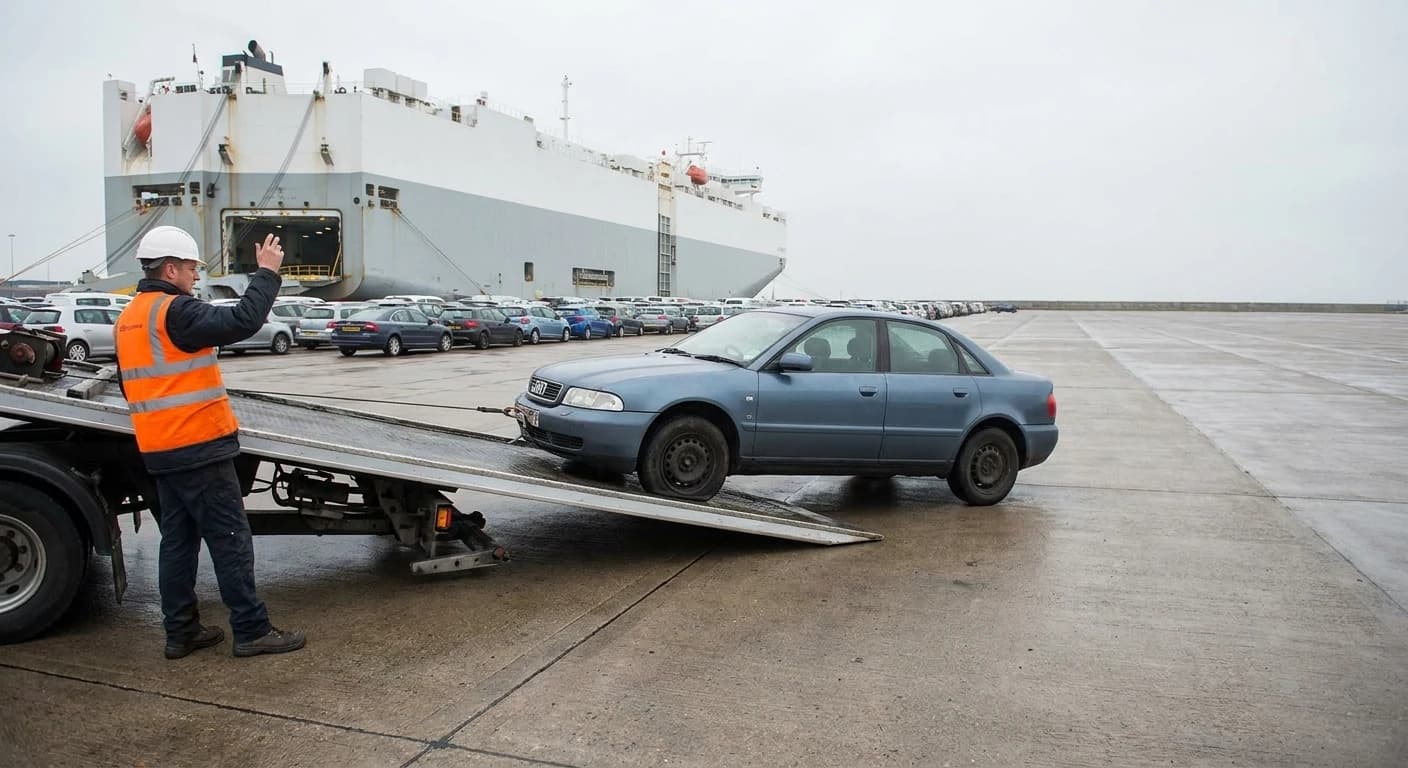
A vehicle that does not drive changes almost everything downstream. It changes how it is loaded, where it can be parked so a recovery truck can still reach it, which carriers will take it, and what the move costs. Those decisions are made by different companies at different times, and all of them are made before anyone sees the car.
That is why the useful question is not whether your system can record a non-runner. It is whether the record travels. A note on a booking is read by the person who opens that booking. A declared attribute on the unit reaches the terminal that has to allocate the space and the carrier that has to accept the load.
It is also worth separating two things that get confused. Mobility is how the vehicle moves: it drives, it has to be towed, forklifted, or it runs on tracks. A hold is something stopping the vehicle from moving at all, like a customs clearance issue. They are different fields answering different questions, and treating one as the other is how a non-runner ends up looking like a blocked unit, or a blocked unit gets loaded.
The declaration
Mobility is a field on the vehicle, with five values rather than a yes or no
A unit is a runner, a non-runner, fork lifted, towed or tracked. It is captured on the unit itself, at booking, alongside the VIN and the dimensions, so it is available to everything that reads the unit rather than to whoever happens to open the booking. Changing it later is a permissioned action and the system records the reason it changed.
The declaration
Mobility is a field on the vehicle, with five values rather than a yes or no
A unit is a runner, a non-runner, fork lifted, towed or tracked. It is captured on the unit itself, at booking, alongside the VIN and the dimensions, so it is available to everything that reads the unit rather than to whoever happens to open the booking. Changing it later is a permissioned action and the system records the reason it changed.
Where the declaration goes after it is made
It is set on the unit at booking
Mobility sits beside the VIN, the make, the dimensions and the cargo category as a first-class field rather than free text. That is what makes it readable by everything downstream instead of by a person.
The terminal keeps its own value
There are two fields, not one: what was declared, and what the terminal recorded. A terminal user with the right permission can set the terminal's own mobility value when manual mobility is enabled. That matters because the car that was booked as a runner and arrived dead is a common event, and the disagreement between the two values is the useful signal.
It changes what the move costs
Handling rules are keyed on mobility, so a non-runner carries its own handling charge and shows as a separate line at invoicing rather than being absorbed. The commercial consequence of the declaration follows the declaration automatically.
It reaches the carrier in their own language
Where the booking is built over a carrier integration, the mobility value is translated into the carrier's own load-mode field, because the carrier does not use our vocabulary. A non-runner becomes a towed load mode on the booking the carrier receives.
It is countable afterwards
Booked-unit reporting carries the non-runner share as a percentage of units on the ground, so the question of how much of this you are actually handling has an answer rather than an impression.
Where non-runners actually cost money
Found at the gate
The most expensive place to discover a car does not start, because the slot is allocated, the carrier is booked and the recovery equipment is not there. Everything after that is rework carried out at short notice.
Parked where nothing can reach it
A non-runner placed in a tight row has to be recovered before it can be moved, which means moving the vehicles around it first. Knowing at allocation time is what avoids that, and allocation happens before arrival.
Quoted as if it drives
If the rate is built without the handling the vehicle actually needs, the cost appears later as an unbilled recovery. The charge has to follow the attribute rather than being remembered by whoever raises the invoice.
Confused with a hold
A unit that cannot move because customs has not cleared it is not the same as a unit that cannot move under its own power. Collapsing the two into one flag means neither question can be answered cleanly.