"Do we need a yard management system or a terminal operating system?" is one of the most common questions in a RoRo terminal software evaluation, and it is the wrong question. The two are not competing answers to the same need. A yard management system organises space and movement. A terminal operating system owns the cargo lifecycle. They overlap on a narrow band of inventory and movement data, and they complement each other across everything else. Most vehicle terminals need both. The decision that actually matters is not which one to choose, but where the line between them sits and which system holds the truth for each kind of data.
The confusion is understandable. Both systems show you a yard. Both track where a unit is. Both talk about inventory and movements. A vendor pitching either one can demo a screen that looks like the other. But the moment a vehicle has to be booked, manifested, billed, released, and reconciled against a sailed vessel, the difference stops being cosmetic.
What a Yard Management System Actually Does
A yard management system is about physical space and the movement of units through it. Its job is to answer three questions continuously: where is every unit right now, how does it get to where it needs to be next, and in what order should the next moves happen.
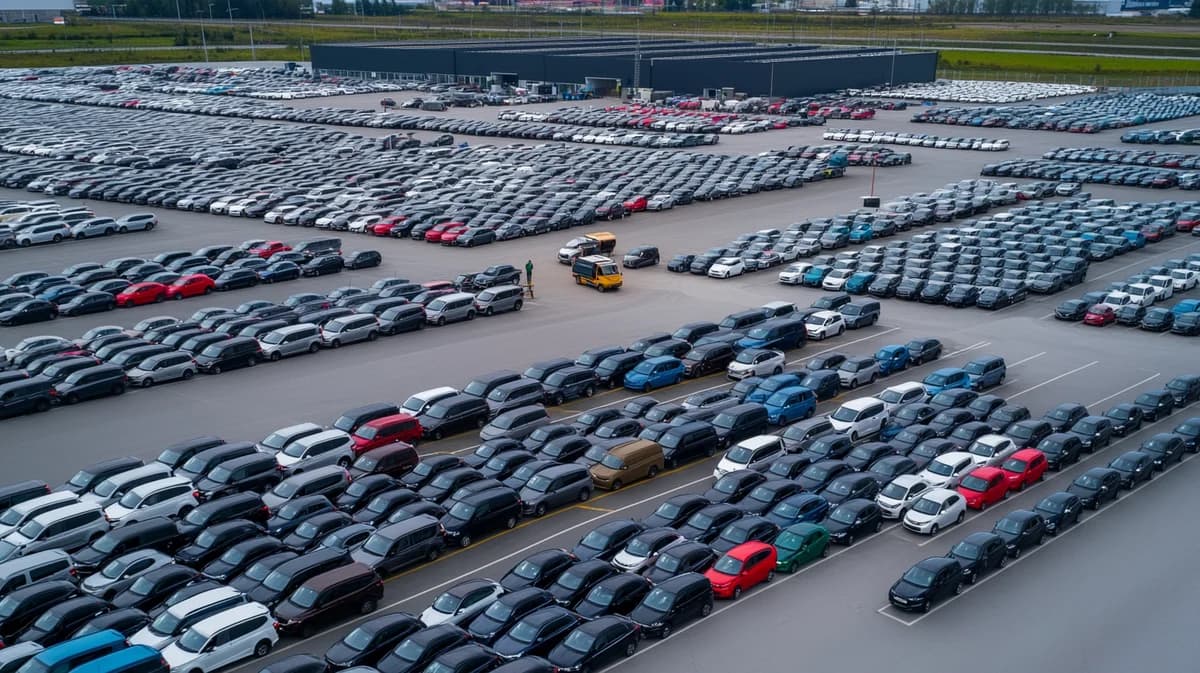
In a RoRo context that means a two-dimensional yard model, not a container stack. Every spot on the grid is independently addressable, because a vehicle has to be retrievable without moving the units around it. A real YMS holds row, lane, bay, and spot hierarchy, assigns arriving units to space against the inbound plan, sequences yard moves to minimise handling, and keeps the position of every unit current as gangs work it.
The strongest yard logic also looks forward. Pre-announcement space allocation reserves yard capacity against a shipping line's declared bookings before the units physically arrive, so the gate is not improvising space on the day. Movement sequencing keeps drivers and gangs from criss-crossing the yard. Occupancy reporting by zone and segment tells operations where the pressure is building.
What a YMS does not do is define what the unit is in commercial terms. It does not know the customer contract, the tariff, the customs status, or the vessel manifest. It knows the unit is in spot D-14-03 and needs to be at the loading ramp by Thursday. That is its entire and legitimate domain.
What a Terminal Operating System Actually Does
A terminal operating system owns the cargo lifecycle from before the unit arrives to after the vessel sails. The VIN is the identity, and the TOS carries that identity through booking, pre-announcement, gate receipt, every chargeable event during dwell, photo-based quality control, load scan, and voyage closure, all on one record.
Around that lifecycle the TOS owns the commercial and regulatory machinery the yard never touches:
- Booking and manifests. The TOS holds the booking from the shipping line, validates arriving units against it, and builds the outbound manifest per vessel at unit granularity.
- Customs and compliance. Declaration status, holds, and release authorisations live on the unit record, so a vehicle under a customs hold cannot be loaded by mistake.
- Billing. Event-driven charging against per-customer tariffs, tiered storage that steps with dwell-day bands, and accessorial charges per move, wash, or inspection. This is where most of a RoRo terminal's revenue is captured, and it has nothing to do with where the unit sits in the yard.
- Voyage closure. Reconciliation of what loaded against what was booked, at VIN level, with exception handling for shut-out units.
- External integrations. Carrier EDI, manufacturer feeds, and customer portals all read from and write to the same unit record.
The TOS is the system of record for what a unit is, who owns it, what it costs, and where it is in its commercial journey. The yard is one chapter of that journey.
The Overlap Zone, and Why "All-in-One" Pitches Mislead
The two systems genuinely overlap on a narrow band: unit inventory and movement tracking. Both need to know that a unit exists and roughly where it is. This is real overlap, and it is the source of every "you only need one system" pitch from both directions.
A YMS vendor points at the overlap and says the TOS yard view is shallow, so buy a dedicated YMS. A TOS vendor points at the same overlap and says a standalone YMS cannot bill or manifest, so the yard module is enough. Both are describing the same 20 percent of shared features and ignoring the 80 percent that does not overlap.
The honest version is this. The overlap is small and it is about inventory location and movement state. Outside that band, a YMS does space and sequencing the TOS yard module may handle more simply, and a TOS does booking, customs, billing, and voyage closure the YMS cannot touch at all. "All-in-one" is only misleading when it claims the overlap is the whole picture. A TOS that includes a deep yard module genuinely covers both domains. A YMS that claims to cover the cargo lifecycle does not.
When You Only Need One
For most RoRo terminals, the practical answer is a TOS with a yard module deep enough that a separate YMS adds an integration seam without adding capability. If the TOS yard logic gives you spot-level topology, pre-announcement allocation, and VIN lookup that returns a unit in seconds, a standalone YMS is solving a problem you no longer have.
A separate, specialised YMS earns its place in a narrower set of cases. Very large compounds where yard optimisation is a science in itself, multi-modal sites where the yard serves rail and road as well as vessel, or operations where an existing best-in-class YMS is already embedded and the migration cost outweighs the integration cost. In those situations a dedicated YMS alongside the TOS is the right call, provided the data ownership is settled before go-live.
What almost never works is a YMS as the primary system. A terminal that runs yard logic well but cannot bill, manifest, or release the units it is organising has automated the middle of the process and left the two ends manual. The system of record has to come first.
How They Should Integrate
When both are deployed, the integration design decides whether the overlap becomes a strength or a source of drift. The rule is simple: each system writes only to the fields it owns.
The TOS is the system of record for inventory. It publishes the unit record, the booking, the customer, the customs status, and the chargeable events. The YMS consumes that record, adds spot-level position and movement state, and writes position changes back to the fields the TOS reads but does not own. Neither system invents a second copy of the unit it then has to reconcile.
In a single-platform deployment this is internal and instantaneous, because the yard module and the cargo lifecycle read and write the same record. Across two vendors it is an API or message integration, and the questions that matter are latency and conflict handling under peak volume. What happens when a unit moves in the yard at the same moment its customs status changes in the TOS? Which write wins, and does the other system see a consistent state a second later? That seam, tested against real peak volume rather than a clean demo dataset, is where yard-versus-cargo data drift is either prevented or built in.
Closing
The yard-versus-TOS question is really a system-of-record question. A yard management system organises space and movement and is excellent at it. A terminal operating system owns the unit from booking to voyage closure and is the only place the commercial and regulatory truth can live. They overlap on a narrow band of inventory and movement, and the terminals that run cleanly are the ones that decided, before go-live, which system owns each domain.
Logisoft builds the terminal operating system as the system of record for the unit lifecycle, with the yard management module covering two-dimensional spot-level topology, pre-announcement allocation, and VIN-level lookup on the same record. Because both run on one platform, the overlap is internal rather than an integration seam, and the line between space and cargo never drifts.
Frequently asked questions
Follow on Google
Keep Logisoft in your Google feed
Mark us as a preferred source and our RoRo and vehicle-logistics coverage shows up more often in your Google Top Stories and AI results.