
How a unit moves is a field, and the price should follow it
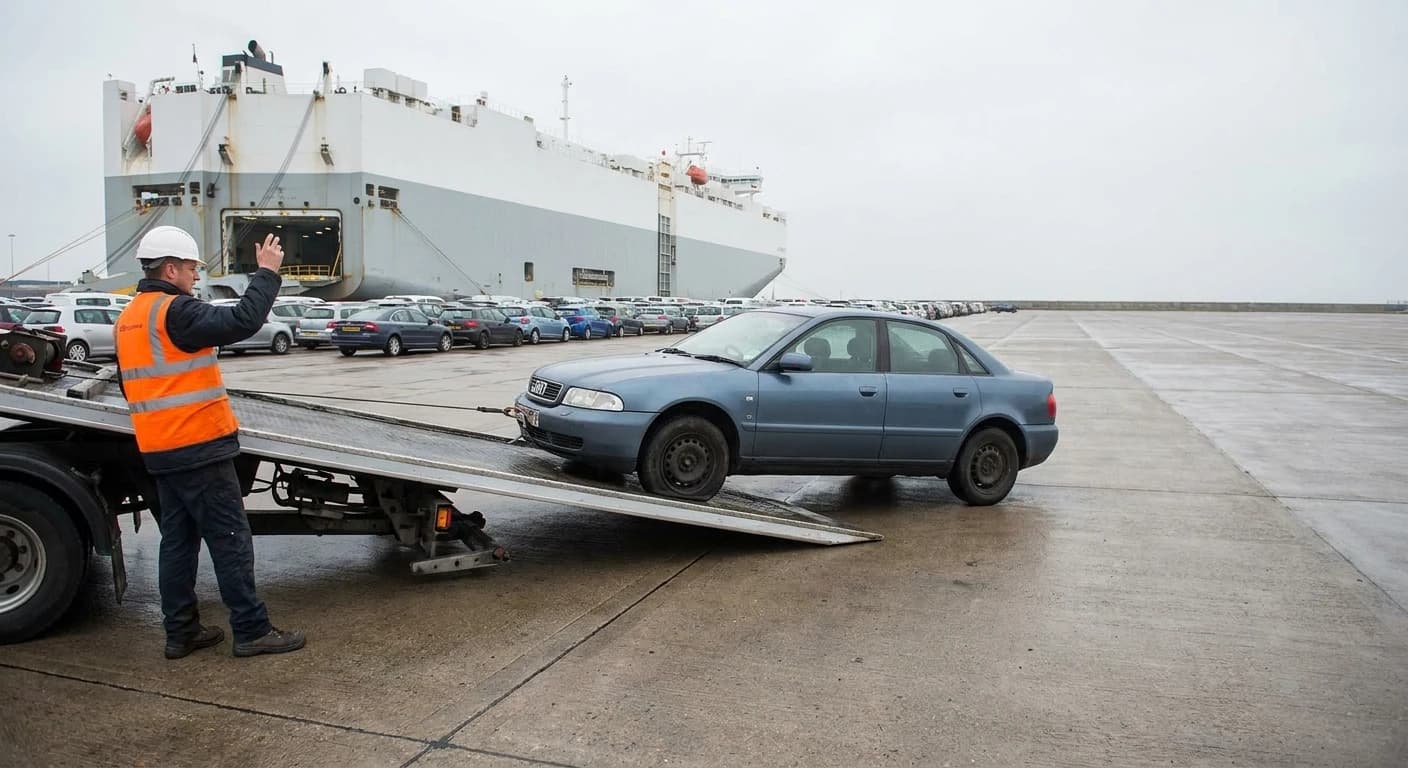
A vehicle drives on, or it has to be towed, forklifted, or moved on tracks. Each needs different equipment, different space and a carrier who accepts it, and each costs something different. Recorded as an attribute on the unit, that is one declaration. Recorded as a note, it is four phone calls.
Mobility is one field with five answers, not a non-runner flag
Most systems that acknowledge this at all reduce it to whether the car starts. That loses the part the terminal actually needs. A unit that has to be forklifted needs different equipment from one that gets towed, and a tracked machine needs different ground and a different approach again. Runner, non-runner, fork lifted, towed and tracked are five different jobs, and the yard is planning for the specific one.
The value also has to travel. Different companies act on it at different times, and all of them decide before anyone sees the vehicle: the terminal allocating a slot a recovery truck can reach, the carrier deciding whether it accepts the load and how it is stowed, and the person quoting it. A note on a booking is read by whoever opens that booking. An attribute on the unit reaches everything that reads the unit.
And it is worth keeping mobility apart from a hold. A hold stops a unit moving at all, for a customs clearance issue or a failed inspection. Mobility says how it moves when it does. Different fields, different questions, and collapsing them means neither can be answered cleanly.
The declaration
Five values on the unit, beside the VIN
Runner, non-runner, fork lifted, towed or tracked, captured on the unit itself at booking alongside the VIN and the dimensions. Because it is a field rather than free text, everything downstream can read it: the yard allocating space, the document set, the charge, and the booking sent to the carrier. Changing it later is a permissioned action and the system records the reason it changed.
The declaration
Five values on the unit, beside the VIN
Runner, non-runner, fork lifted, towed or tracked, captured on the unit itself at booking alongside the VIN and the dimensions. Because it is a field rather than free text, everything downstream can read it: the yard allocating space, the document set, the charge, and the booking sent to the carrier. Changing it later is a permissioned action and the system records the reason it changed.
The charge follows the attribute, without anyone remembering
This is the part that decides whether the declaration is worth making. Mobility is one of the dimensions an automatic charging rule matches on, sitting alongside the client, the agent, the NVOCC, the shipping line, the vessel and the validity dates. So a rule is not limited to non-runners. Write one for forklifted units, or for tracked plant, and it applies to every unit carrying that value.
When charges are generated, the rules are matched against the mobilities actually present on the units, and a rule with no mobility set matches anything. Where both exist, the mobility-specific rule is preferred over the generic one, so a general handling charge and a towed-unit surcharge do not fight each other. Rules carrying a mobility can also be imported in bulk rather than keyed one at a time.
The practical effect is that a unit declared as towed prices as a towed unit from the moment it is declared, and the recovery that used to surface weeks later as an unbilled cost appears on the quotation instead.
Where the value goes after it is set
It is set on the unit at booking
Mobility sits beside the VIN, the make, the dimensions and the cargo category as a first-class field rather than free text. That is what makes it readable by everything downstream instead of by a person.
The matching charge applies automatically
Charging rules can be scoped to a mobility value the same way they are scoped to a client or a vessel. The unit carries the value, the rule matches it, and the surcharge lands per unit without anyone remembering to add it.
The terminal keeps its own value
There are two fields, not one: what was declared, and what the terminal recorded. A terminal user with the right permission can set the terminal's own mobility when manual mobility is enabled. The car booked as a runner that arrives dead is routine, and the disagreement between the two values is the evidence behind the recovery charge.
It reaches the carrier in their own language
Where the booking is built over a carrier integration, the value is translated into the carrier's own load-mode field, because the carrier does not use our vocabulary. A unit that cannot drive becomes a towed load mode on the booking the carrier receives.
It is countable afterwards
Booked-unit reporting carries the non-runner share as a percentage of units on the ground, so how much of this you are actually handling has an answer rather than an impression.
Where mobility costs money when it is not declared
Found at the gate
The most expensive place to discover a unit does not drive, because the slot is allocated, the carrier is booked and the equipment is not there. Everything after that is rework at short notice.
Parked where nothing can reach it
A unit needing recovery placed in a tight row has to be dug out before it can move. Knowing at allocation time avoids that, and allocation happens before arrival.
Quoted as if it drives
If the rate is built without the handling the unit actually needs, the cost appears later as an unbilled recovery. The charge has to follow the attribute rather than be remembered by whoever raises the invoice.
Reduced to a yes or no
Treating this as a non-runner flag throws away the instruction. Forklifted and towed describe how a unit will actually be handled, which is what the yard is planning for, and tracked plant is a different job again.